Understanding the specific nature of auditory impairment is the first step toward effective management and rehabilitation. When you visit an audiologist, the diagnosis isn’t just “hearing loss”; it is a specific categorization based on where the breakdown occurs in your auditory system.
The medical community classifies auditory dysfunction into three primary categories: Sensorineural Hearing Loss, Conductive Hearing Loss, and Mixed Hearing Loss.
Identifying which of these hearing loss types affects you or your patients is critical because the treatment path—ranging from medical intervention to the prescription of advanced hearing aids—depends entirely on this classification. This guide provides a deep dive into the anatomy, causes, and solutions for each type.

1. Sensorineural Hearing Loss (SNHL)
By far the most prevalent form of auditory impairment, Sensorineural Hearing Loss accounts for the vast majority of adult cases. When you hear professionals discuss “permanent hearing loss,” they are almost always referring to this type.
What is sensorineural hearing loss?

Common Causes of SNHL
If you are diagnosed with SNHL, it is likely due to one of the following factors:
- Presbycusis (Aging): This is the gradual loss of hearing that occurs as you get older. It is a natural part of the aging process, typically affecting high-frequency sounds first.
- Noise Exposure: Long-term exposure to loud noise (machinery, music) or a sudden burst of sound (an explosion) can destroy hair cells. This is known as Noise-Induced Hearing Loss (NIHL).
- Ototoxic Medications: Certain classes of drugs, including some antibiotics and chemotherapy agents, can be toxic to the inner ear.
- Genetics: Hereditary factors play a significant role in susceptibility to inner ear damage.
- Viral Infections: Viruses such as measles, mumps, or severe flu can attack the auditory nerve.
Symptoms of sensorineural hearing loss
With SNHL, you don’t just experience a reduction in volume; you experience a reduction in clarity. You might hear people speaking, but you cannot distinguish the words. This is often described as “mumbled” speech. High-pitched sounds, like the voices of women or children, become particularly difficult to understand.
How can you deal with sensorineural hearing loss?
Because the damage involves the nerves and inner ear structures, SNHL cannot usually be corrected medically or surgically. The most effective treatment is the use of hearing aids. Modern digital hearing aids are designed specifically to amplify the frequencies you have lost while filtering out background noise, significantly improving speech intelligibility. In cases of profound loss where hearing aids provide limited benefit, cochlear implants may be considered.
2. Conductive Hearing Loss
Unlike sensorineural loss, Conductive Hearing Loss is often temporary and, in many cases, medically or surgically treatable. This type of hearing loss essentially involves a “roadblock” that prevents sound from traveling through the outer or middle ear to the inner ear.
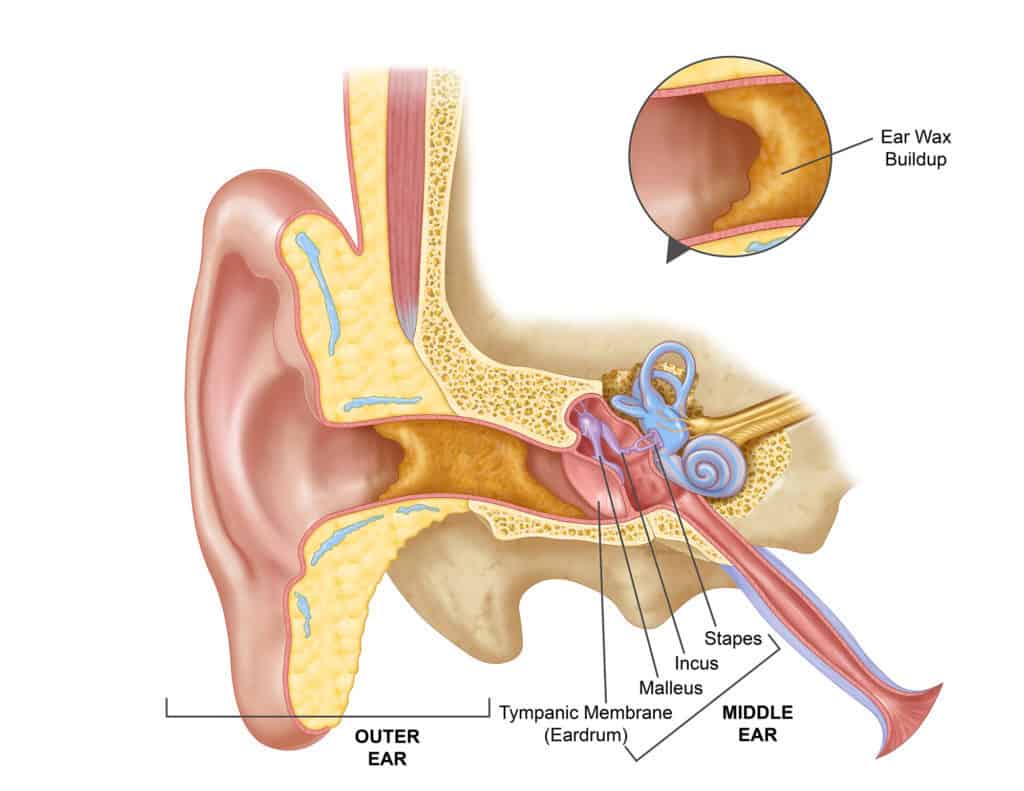
The Mechanics of Conductive Loss

Causes of conductive hearing loss
Several physical issues can trigger conductive hearing loss:
- Cerumen Impaction (Earwax): The most common and easily treatable cause. Hardened wax blocks the ear canal.
- Otitis Media (Ear Infection): Fluid buildup or infection in the middle ear prevents the eardrum from vibrating correctly.
- Perforated Eardrum: A tear in the tympanic membrane caused by trauma or pressure changes.
- Otosclerosis: A condition where the stapes (one of the middle ear bones) becomes fixed in place and cannot vibrate.
- Malformation: Structural abnormalities of the outer or middle ear present at birth.
Symptoms of conductive hearing loss
If you have conductive hearing loss, you might feel like your ears are “plugged” or “full.” Your own voice may sound louder to you (the occlusion effect), while external sounds are faint. Unlike SNHL, clarity is usually preserved once the volume is increased enough to bypass the obstruction.
How can you deal with conductive hearing loss?
Treatment focuses on removing the obstruction. This might involve:
- Professional earwax removal.
- Antibiotics for infections.
- Surgery to repair the eardrum or replace immobilized bones (stapedectomy).
if medical or surgical options are not viable or fail to restore hearing, conventional hearing aids or bone-anchored hearing systems (BAHA) are highly effective. Since the inner ear is healthy, the hearing aid simply needs to deliver enough volume to overcome the conductive block.
3. Mixed Hearing Loss
Mixed Hearing Loss is a combination of both sensorineural and conductive hearing loss occurring in the same ear. This is a complex presentation that requires a dual approach to treatment.
What is mixed hearing loss?

Causes of mixed hearing loss
Audiologists identify this through an audiogram by looking for an “air-bone gap.” This means your hearing is better when tested via bone conduction (vibrating the bone behind the ear) than air conduction (sounds through headphones), but your bone conduction thresholds still show some degree of loss.
Symptoms of mixed hearing loss
Treating mixed hearing loss is a multistep process:
- Address the Conductive Component: Doctors will first attempt to treat the outer or middle ear issue (e.g., clearing the infection or removing wax).
- Address the Sensorineural Component: Once the conductive element is stable, the remaining permanent hearing loss is managed with hearing aids.
Degrees of Hearing Loss
Identifying the types of hearing loss is only half the equation; understanding the degree or severity is equally important. Hearing loss is measured in decibels (dB) of hearing level (HL).
Mild Hearing Loss (26 to 40 dB HL)
You may hear conversation well in quiet environments but struggle significantly in noisy restaurants or when the speaker is at a distance. Soft sounds like rustling leaves or ticking clocks are inaudible.
Moderate Hearing Loss (41 to 55 dB HL)
You likely ask people to repeat themselves frequently. Standard conversational speech requires concentration to follow. The TV volume is likely set higher than what others find comfortable.
Moderately Severe Hearing Loss (56 to 70 dB HL)
Conversation at a normal level is difficult to hear. You rely heavily on visual cues (lip-reading) to supplement what you hear. Hearing aids are essential for daily communication.
Severe Hearing Loss (71 to 90 dB HL)
You cannot hear people speaking without amplification. You may hear loud environmental noises (like a dog barking or a siren) but miss almost all speech sounds.
Profound Hearing Loss (91+ dB HL)
Often referred to as deafness. You may only feel very loud vibrations. High-powered hearing aids or cochlear implants are the standard intervention.
Unilateral vs. Bilateral Hearing Loss
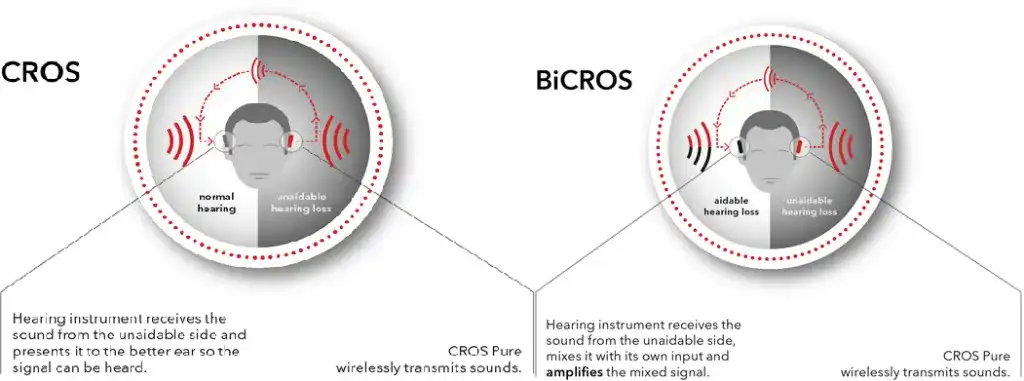
It is possible to have perfect hearing in one ear and a hearing loss in the other.
- Unilateral Hearing Loss: Affects only one ear (also known as Single-Sided Deafness). This makes localizing sound (knowing where sound is coming from) very difficult.
- Bilateral Hearing Loss: Affects both ears. The type and degree can be symmetrical (same in both ears) or asymmetrical (different in each ear).
Auditory Neuropathy Spectrum Disorder (ANSD)
While often grouped under sensorineural loss, ANSD deserves a mention. In this condition, the inner ear successfully detects sound, but the signal is not sent correctly from the ear to the brain. The sound enters, but the information becomes “scrambled.” People with ANSD may hear sounds but have extreme difficulty understanding speech, regardless of volume. Traditional amplification needs to be carefully adjusted for these cases.
Why Early Diagnosis Matters
Ignoring the signs of hearing loss does not make the problem go away. In fact, untreated hearing loss is linked to cognitive decline, social isolation, and depression. The brain pathways responsible for processing sound can atrophy if they are not stimulated—a phenomenon known as “auditory deprivation.”
Whether you are facing conductive issues that need medical attention or sensorineural loss requiring amplification, the technology available today is vastly superior to what was available even a decade ago.
Conclusion
To summarize, the three main types of hearing loss are Sensorineural (permanent inner ear/nerve damage), Conductive (mechanical blockage in the outer/middle ear), and Mixed (a combination of both). Accurately identifying the type and degree of loss is the cornerstone of effective treatment. While conductive loss can often be cured medically, sensorineural and mixed losses largely rely on the advanced technology found in modern hearing aids to restore quality of life.
Are you looking for reliable, high-performance hearing solutions? Spieth are a premier hearing aid manufacturer dedicated to restoring the sound of life for individuals worldwide.
We specialize in the research, development, and production of cutting-edge hearing devices that address all types of hearing loss discussed above. From sleek Receiver-in-Canal (RIC) models ideal for high-frequency sensorineural loss to powerful Behind-the-Ear (BTE) units for severe mixed loss, our product portfolio is designed with precision and user comfort in mind.
Why Choose Our Technology?
- Advanced Digital Signal Processing (DSP): Our chips distinguish speech from noise with exceptional accuracy.
- OEM/ODM Services: We provide customized manufacturing solutions for brands looking to expand their product lines.
- Quality Assurance: Strict adherence to international medical device standards ensures durability and safety.
- Factory Direct Pricing: Get the best technology without the middleman markup.
FAQ
1. What is the most common of the three types of hearing loss?
Sensorineural Hearing Loss (SNHL) is the most common type. It accounts for about 90% of all reported hearing loss cases in adults. It is typically caused by aging (presbycusis) or noise exposure and involves permanent damage to the inner ear.
2. Can you have different types of hearing loss in each ear?
Yes. It is possible to have sensorineural loss in one ear (perhaps due to noise exposure) and conductive loss in the other (perhaps due to an infection). You can also have normal hearing in one ear and hearing loss in the other.
3. Is conductive hearing loss permanent?
Not usually. Conductive hearing loss is often temporary. It is frequently caused by obstructions like earwax, fluid, or ear infections, which can be treated medically or surgically. However, if left untreated for a long time, it can lead to permanent damage.
4. How do I know which type of hearing loss I have?
You cannot diagnose the type of hearing loss yourself. You need to see an audiologist or an ENT specialist. They will perform an audiogram, which includes air conduction and bone conduction testing. If your bone conduction is normal but air conduction is not, you have conductive loss. If both are equally affected, it is sensorineural.
5. Do hearing aids work for all three types of hearing loss?
Yes, hearing aids are effective for all three types, but they are the primary treatment for Sensorineural and Mixed hearing loss. For Conductive hearing loss, medical or surgical treatment is usually the first step, but hearing aids are an excellent solution if medical treatment is not possible or effective.